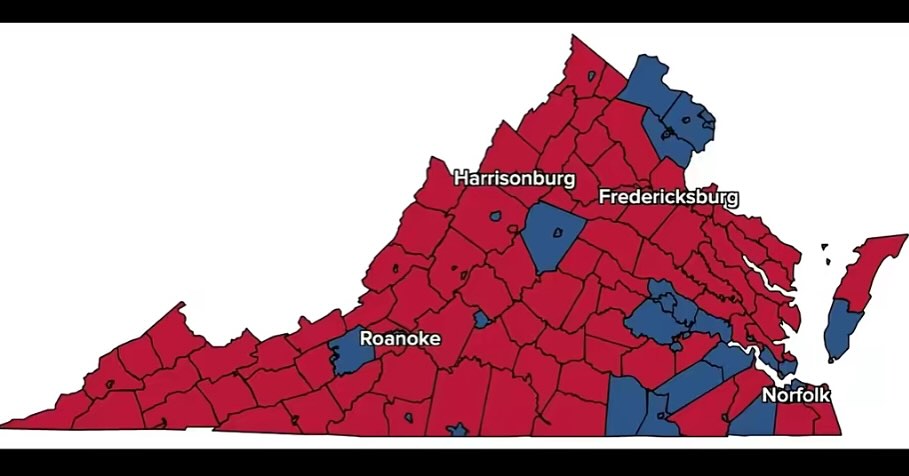
The map shows Virginia’s 95 counties and 38 independent cities. Red represents Republican candidate Winsome Earle-Sears and blue represents Democratic candidate Abigail Spanberger. Sure, this map gives the visual impression that Virginia wanted a Republican governor. But remember: Land doesn’t vote, people vote.
What would happen if you followed the “people vote” principle and scaled the map so that the area of each county was not determined by its land area, but by the number of people who voted? Here is what the map looks like:
This kind of map, where size is determined not by real-life size but by population or some other variable, is called a “cartogram.” It is a much fairer representation of what voters want for the Governor of Virginia.
It’s not perfect – remember that counties don’t vote, people vote. The map is all-or-nothing, ignoring all votes for Earle-Sears in blue counties and all votes for Spanberger in red counties. Elections are all or nothing, but they are all or nothing at the state level, not the county level. A better representation would show counties in shades of purple corresponding to the percent vote for either candidate. And I might make that map someday. (Also, the counties are not in their true positions – I just moved them around in an effort to make the graph look roughly like Virginia.)
But this map gives a clear answer to the question “Did Virginia voters want to elect a Democratic governor?” And the answer is Hell Yes.
How did I do it? See the code I ran to generate the map. The code outputs an .svg file. The file has many counties overlapping, so I used Adobe Illustrator to move the counties around until they were all visible.
Want to do it yourself? Create an account on SciServer, the science platform that allows you to upload, analyze, and visualize data in a web browser (and which is my day job). Email me your username and I’ll help you access the data. You can get the code from my election cartograms GitHub repository.
It’s hard to even imagine the devastation visited on the city of Derna, Libya this week by flooding and resulting dam burst. This report from the BBC includes some drone footage that might hint at what people there are going through:
The upper estimate for the number of people killed in the dam burst catastrophe in Derna, Libya is 20,000 people. For comparison, that’s about the size of Westminster, Maryland or Maitland, Florida.
Imagine Westminster or Maitland suddenly wiped off the map, washed out to sea by a hundred-foot wall of water.
Postscript: some other places with a population of approximately 20,000 that you might be more familiar with:
The Wuhan South China Seafood Market as seen from the street
Three years ago, right about this time, a killer was beginning to kill. We had no idea at the time, but our lives were about to change forever.
Word began to spread on December 31st, 2019. That day, the Municipal Health Commission of Wuhan, China told the World Health Organization (WHO) that a cluster of pneumonia cases of unknown cause had been observed in the city. That cause, of course, would turn out to be the new disease now known as COVID-19. Disease detectives from WHO and other organizations began to trace the contacts of people who had been infected. And their search led them to the one place that nearly all patients had visited:
The Huanan Seafood Wholesale Market
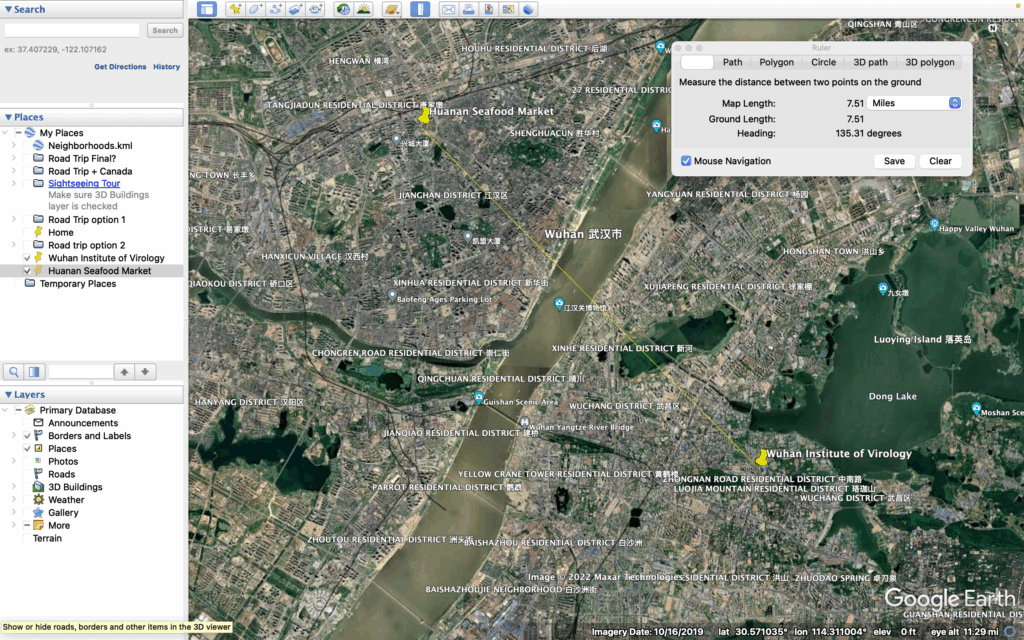
The map above shows the Huanan Seafood Market (in Chinese, 武汉华南海鲜批发市场, Wǔhàn Huánán Hǎixiān Pīfā Shìchǎng) was a market at 207 Fa Zhan Da Dao in the Jiangshan District in the city of Wuhan, in east-central China. It appears to have been torn down, but this Google Earth historic image shows what it looked like from space in October 2019, right around the time the virus likely arrived there:
The Huanan Seafood Market from space in October 2019 (from Google Earth)
And of course the photo at the top of the post shows what it looks like from the street.
Wuhan is huge – home to 12 million people – nearly twice the population of New York City. And Huanan Seafood Market was the largest market of its kind in the city. It frequently gets described in English-speaking media as a “wet market,” but I don’t actually know what that means, so I’ll just call it a market.
The market sold mostly fish and other seafood, but one section specialized in wild game – what in Chinese is called 野味 (Yěwèi), meaning “wild taste.” Wild game can mean just about anything; an old South Chinese saying is that “Chinese people will eat anything with four legs except a table.” Although the wild ancestor of the human SARS-CoV-2 virus has its reservoir in bats, genetic evidence suggests that it passed through another organism before arriving in humans. The most likely culprit is the pangolin, a small, endangered, adorable mammal native to south China, and formerly a popular wild game animal until its consumption was banned in China in mid-2020.
From bats to pangolins to the seafood market to a few unknown humans, the virus began its spread around the world, as I had tracked for quite a long time on this blog (like this just one of tragically many updates).
As the virus spread around the world, so too did false conspiracy rumor about the spread of the virus. One of the most powerful and lasting has been the rumor that the virus was genetically engineered by humans, either as a bioweapon by the Chinese government or escaped in a lab accident. The rumor started in February 2020, spread quickly online and in person by many well-meaning people and… not well-meaning people.
If the mountains of epidemiological and genomic evidence isn’t enough to convince any of the well-meaning people who have shared this rumor, this probably won’t be either. But for what it’s worth…
I recently saw an Internet Opinion Piece asking: how likely is it that the outbreak started at the market rather than at the virology lab LESS THAN ONE MILE AWAY???!!!1!!??
Surely the Internet wouldn’t lie about such an easily verifiable fact, right? lol
The distance between the Wuhan Institute of Virology and the Huanan Seafood Market: 7.5 miles
Conspiracy rumors and false information rely on passive consumers who don’t even bother to check whether what they are reading is true. Always check!
Welcome to an annual series I haven’t actually done on the blog yet: April Fools’, except it’s not.
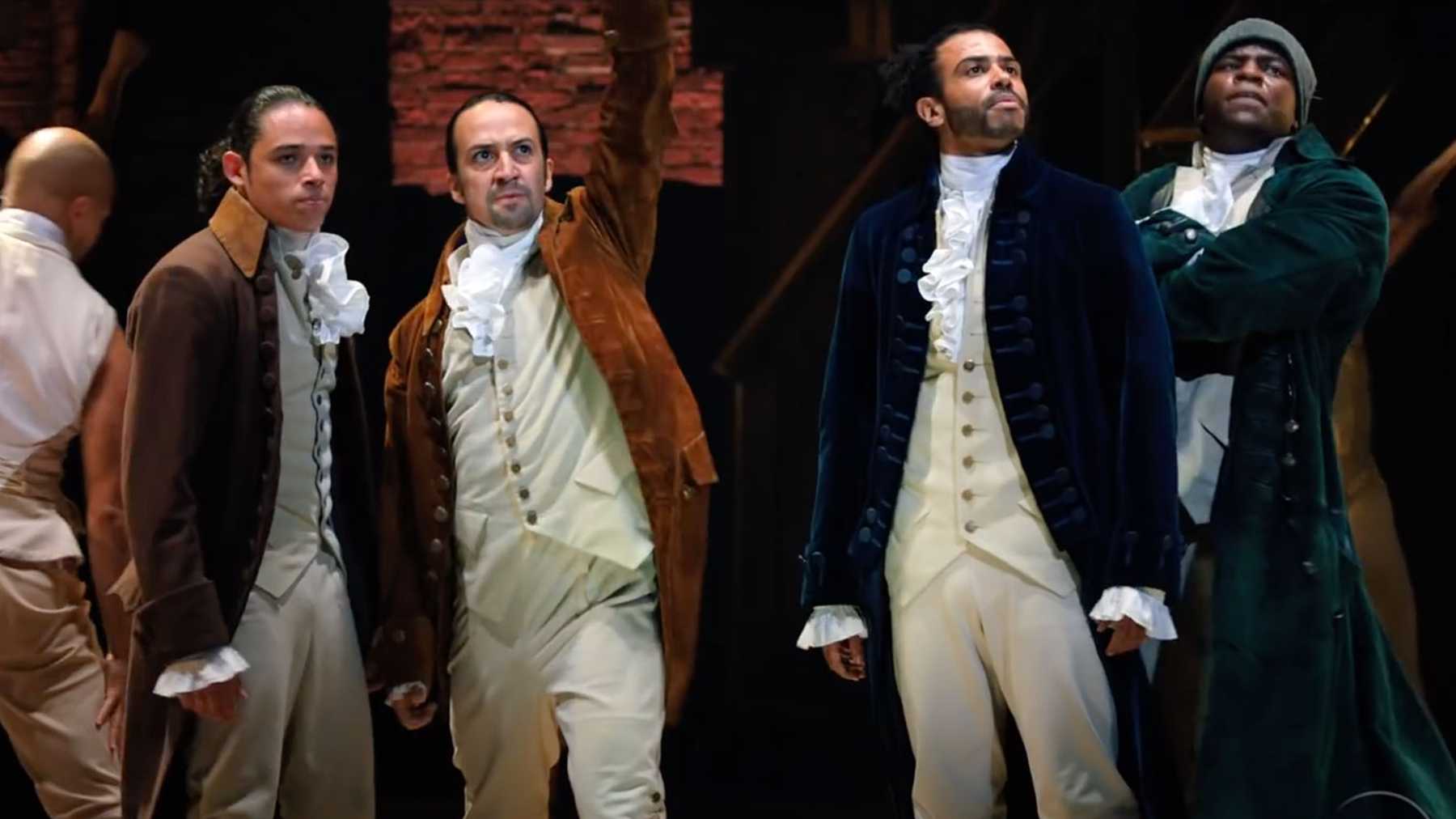
The hottest ticket on Broadway is [rolls d20]…. a hip-hop musical about treasury secretary Alexander Hamilton?
The concept is simple: write about the modern world in such a way that it would sound like a bizarre April Fools’ joke to someone from the past. I wrote a version of this on social media in 2015 and 2016, but then in 2017 the joke stopped being funny. Fortunately, “Donald Trump was the President of the United States” actually is much funnier than “Donald Trump is the President of the United States,” so the joke can come back.
So imagine that it’s April 1st, 1999, and you have just received this letter from the future. Pretty good joke, right?
Except it’s not.
Dear 1999 fool,
The year is 2021, and the United States has been at war for 19 years.
Everything has changed in the two decades since terrorists destroyed the World Trade Center, but the truth is the war has been going on for so long that it hardly ever makes the news anymore. Instead, the big news is something far more deadly: a new disease called COVID-19 has become a global pandemic that has killed nearly three million people and counting.
“What?,” cried the Ant in surprise. “Haven’t you stored anything away for the winter?” “STFU LIBNAZI,” replied the Grasshopper.
Fortunately, the end is may finally be in sight. We have four separate vaccines, created semi-collaboratively by four separate pharmaceutical companies at never-before-imagined speed. But 25 percent of Americans say they would rather take their chances with catching a deadly disease. We also know that wearing a thin cloth mask over your nose and mouth can cut the probability of transmission to near zero, but many people are saying that being told to wear a thin cloth mask over your mouth and nose is just like the Holocaust. It’s like the fable of the Ant and the Grasshopper, except that instead of the Grasshopper laughing at the Ant’s warning, the Grasshopper calls him a Nazi.
The current and former Presidents of the United States
President Joe Biden has promised that vaccines will be available to all Americans by May 1st. Yes, that Joe Biden, who is still around at age 78, his 1980s-era scandals forgotten. But that’s not even the weird part. The weird part is that the previous president was Donald Trump. Yes, that Donald Trump. The national debt increased so much during the Trump administration that Republicans are now saying that the national debt isn’t so bad. Trump also claimed, with no evidence at all, that he was the real winner of last year’s Presidential election that he lost. His wife once posed for a nude lesbian photo shoot, but don’t worry, the Trumps oppose gay marriage.
Gotta catch ’em all!
Remember last year when Republicans impeached President Clinton for having an affair with an intern? Republicans now say that the President’s personal life doesn’t matter and the President should never be impeached for any reason.
If you’re into technology and have enough disposable income, you might have a cell phone – today, everyone has them. My phone comes with a video camera, a television, and music player to listen to songs like last year’s number one song, WAP (which of course stands for wet-ass pussy). It also offers instant access to all the knowledge of the world. I use it to catch Pokemon.
Have you heard of Tom Brady, the backup quarterback for the University of Michigan? He has now won seven Super Bowls, more than any single NFL team. But in Brazil he is still mostly known as Gisele Bündchen’s husband.
For the rest of 2021, we’re all looking forward to… anything, really. We’ve all been stuck inside for so long due to COVID-19. Here’s to better times ahead!
The hottest toy of the 1985 Christmas season was an Extraordinary Video Robot that could play games through your television.
Except it wasn’t.
The “robot” in that 1985 commercial was R.O.B. (Robot Operating Buddy), which shipped with early copies of the Nintendo Entertainment System (NES) to test markets in New York and Los Angeles. The NES proved to be a big hit in those test markets, and so the console rolled out throughout the U.S. over the next year – but without R.O.B. Why?
The best way to explain R.O.B. is to show him in action. It’s a collector’s item today, available on eBay for anywhere from $20 to $500 depending on its condition. To use R.O.B., power it on, plug in the second NES controller into the base unit, and load onr of the two games that works with it, Gyromite or Stack-Up.
The youtube channel videogamecollector shows what it looks like running, and it’s very cool:
R.O.B. in action
…but beneath all the spinning and blinking and robot noises, here’s what R.O.B. was really doing: pressing the select button on the second controller. Which means that you could play the same two games much more easily without R.O.B., simply by pressing the select button on the second controller.
Why would Nintendo design something so complicated and so utterly pointless? It wasn’t a robot, it was a trojan horse. R.O.B.’s entire purpose was to hide the fact that the NES was a video game system.
And why would Nintendo of America want to hide the fact that their beautifully designed video game system was a video game system? Remember that this was fall 1985, before the wild success of the NES. But for a full answer, we need to look back even farther into the history of video games.
The first commercially successful video game was Pong, released in 1972 and still bizarrely addictive today. Following Pong, many other of these new “video games” were released to the new video arcades that were springing up all over the United States. As arcades became more and more popular, video game makers began to wonder how to bring the experience into their customers’ homes. After a few false starts, the first massive hit was the Atari 2600, released in 1977.
Manufacturers created hundreds and hundreds of games for the Atari system – and that was the problem. With so many titles clogging store shelves, and with a medium so new that there were not yet any reviews, customers had no way to tell good games from bad games.
The final indignity was the officially licensed E.T. video game, released in time for Christmas 1982. Atari spent millions to acquire the rights to what was at the time the highest-grossing movie of all time, and millions more on marketing, but left the game to a single developer to rush out in six weeks. The results were famously terrible:
A playthrough of the famously terrible E.T. game for the Atari 2600, from J.C.’s Channel on YouTube
Millions of American children woke up on Christmas morning to a shiny new copy of Atari’s E.T., only to have their joy turn to despair within minutes of starting up the boring, bug-filled mess above. Word quickly spread, sales dried up, and retailers were stuck with millions of unsold copies sitting on shelves. They sent the cartridges back to Atari, who had no choice but to take the loss and bury them in a New Mexico landfill.
It wasn’t just E.T.; every other game and even every other video game system completely dried up. Atari nearly went bankrupt, staying in business only by reorganizing and selling off its software division. Industry analysts declared that the fad was over; there was no more consumer demand for video games. That state of affairs continued for years. And that was the situation that Nintendo of America found itself in in fall 1985.
Nintendo had good reason to believe that video games would take off again – there was no video game industry crash in Japan, and their Famicom system had sold steadily there since 1983. And they thought they knew the cause of the crash and what to do about it. They would have strict quality control over all the games on their system, made possible by a licensing agreement and enforced by a lockout chip preventing unlicensed games from playing. They would create an in-house magazine to offer reviews, previews of future games, and strategy information to players. But even with all these efforts in place, they still had a major hurdle to overcome to get their new system to consumers.
This was 1985, years before online shopping was even a dream. To even get the chance to sell to customers, Nintendo knew it first had to sell to retailers who were understandably skeptical of video games after the crash of 1983.
So how do you sell a video game system to people who don’t like video games? Tell them it’s totally not a video game system! It’s an ENTERTAINMENT SYSTEM! And R.O.B. was a key part of that strategy. It looked like a toy, so retailers concluded that it must be a toy – and they marketed it like any other toy. Nintendo proved to be absolutely right about the NES. And as you can see below, thirty-five years later: the rest is history.
A recent world speed record for completing Super Mario Brothers, 4 minutes 55.64 seconds, by YouTube’s Kosmic.