The Flag Test

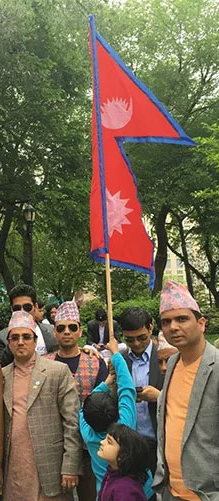
A man holds the flag of Nepal at a paradeIf there’s one thing I am obsessed with – other than democratizing science, learning from data, evidence-based practice, people who aren’t what they seem, exploring the world with Google Earth, and Australian Rules Football – it’s flags.

A flag is a symbol of a group of people, a source of pride, and looks beautiful waving in the breeze. A flag represents all the best and worst impulses of humanity. When they all come together, like at the United Nations, you get a real sense of how we all come together as a world.

I’m not alone; there is a large and somewhat nerdy community of flag lovers called vexillophiles, from the Latin for “lover of flags.” We have an unofficial website, multiple YouTube channels, and an international organization (which of course has its own flag.

In my interactions with fellow vexillophiles, I have discovered an informal, tongue-in-cheek personality test, which is:

What do you think of the flag of Nepal? Is it kind of cool, or is it an Abomination Unto Flags?

Flag_of_Nepal

The flag of Nepal, shown in the photo above and the illustration here, is the world’s only non-rectangular national flag (although there are some sub-national nonrectangular flags, most famously the state of Ohio and the city of Tampa, Florida). It consists of two red triangles, the bottom one slightly larger. The top triangle has a stylized, symbolic drawing of the moon, and the bottom has a similar drawing of the Sun. Both triangles are outlined with a thin blue border.

To be in the first category, you don’t have to like the flag, it’s enough to say, “that’s kind of cool, I respect what they were going for there.” Being in the second category requires strong opinions about what does or does not constitute a “real” flag.

Your opinion on the Nepal flag correlates with many other things, especially your opinion about whether people should get off your lawn. It’s not an absolute predictor, and of course correlation is not causation, but it’s an effect that I have noticed.

Zero guesses which side is the “get off my lawn” side, and zero guesses which side I’m on.

(Spoiler alert, highlight to reveal: It’s cool.)

Nepal flag photo: Hom Lamsal, Nepal Republic Media
Nepal flag illustration: Wikimedia users Pumbaa80 and Achim1999.

Except they weren’t: Iron Eyes Cody

Except they weren’t: An occasional series about people and things which are Not What They Seem

A middle-aged Iron Eyes Cody, dressed in a traditional Native American cloak and with a feather on his head, in an undated publicity photo

To three generations of movie fans, Iron Eyes Cody was THE Hollywood Indian. He was born in Oklahoma in 1904 to a Cherokee father and a Cree mother. He spent his youth performing in traveling Wild West shows, where he taught himself the sign languages of other Nations. In 1924, he moved to California, and within two years was appearing as an uncredited extra in Hollywood.

His career took off from there, and he eventually appeared in more than 200 films and TV series, particularly Westerns. He played in films with A-list actors like John Wayne (The Big Trail in 1930) and Steve McQueen (A Man Called Horse in 1970). But his most famous role came at age 65 in a Public Service Announcement TV commercial that was an early advocate for environmental conservation movement. It’s horribly dated now, but it had a real impact on changing public attitudes:

Cody wrote an autobiography, died in 1999 at age 94, and is buried in the “cemetery of the stars,” Hollywood Forever Cemetery. He is in the mausoleum with his beloved wife Bertha, not far from stars like Victor Fleming, James Garner, and Marilyn Monroe.

Over a career spanning nearly 70 years, Iron Eyes Cody’s career perfectly traced America’s changing attitudes toward the people known first as Indians, then as American Indians, then as Native Americans — all the while staying true to his heritage as a Native American.

Except he wasn’t.

He was born as Espera Oscar de Corti in small-town Louisiana, the son of two immigrants from Sicily who ran the town grocery store. He moved to California at 19, where he used his dark skin, talent for telling a good story, and genuine acting talent to score a long and successful career as an actor.

The truth began to come out in 1996, when his half-sister gave an interview to the New Orleans Times-Picayune newspaper. de Corti/Cody denied the rumor, but it was officially confirmed after his death.

What do we make of his story? Was this the worst kind of cultural appropriation, the story of a white man literally taking on a fake Native American identity? Was it a well-meaning fib that had a happy ending and actually did some good? Did it start out for convenience, but then eventually de Corti managed to convince himself he really was Cody?

If it helps: he married a for-reals Native American woman, adopted two children from reservations in his fake-home state of Oklahoma, and spent much of his life advocating and fundraising for Native-led charities and causes.

Questions like these are why I find these except-they-weren’t stories so fascinating.

What do you think?

Except they weren’t: Joe Magarac

A statue of Joe Magarac bending a steel beam

I’m fascinated with stories of people who are not what they seem, or are not what they claim to be. History is full of stories of people who hide or change their identities, for all sorts of reasons both good and not-so-good – as well as stories of fictional people who were invented for all sorts of reasons both good and not-so-good. But sometimes the story is so much more interesting, and I’d love to share some of these stories with you. If truth is stranger than fiction, then true fiction is even stranger than that. Welcome to a new occasional series: Except They Weren’t.

What John Henry was to African-American rail workers, Joe Magarac was to steelworkers in Pittsburgh.

In 1931, Pittsburgh author Owen Francis (a former steelworker himself) interviewed a group of immigrant steelworkers from Croatia. They told him of the legend of Joe Magarac, a strong and hardworking folk hero figure who shows up just in time so save his fellow workers from calamity.

Francis wrote up the story for the November 1931 issue of Scribner’s magazine as “The Saga of Joe Magarac: Steelman.” Like the more famous John Henry, Joe Magarac might not have been a real person, but he was a real inspiration to the downtrodden workers of America.

Except he wasn’t.

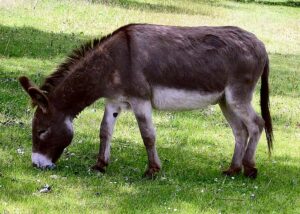
A photo of a cute donkey grazing
Not Joe Magarac

There is no historical record of Joe Magarac before the 1931 article, and when anthropologists interviewed Pittsburgh immigrant steelworkers in the 1940s and 1950s, no one had heard of him. We’ll never know for sure, but it sure looks like the guys were just playing a fun game of troll the reporter. The clincher? Check out what “magarac” means in Croatian.

But in one of those Bizarre Things That Happen Sometimes, the article proved so popular that Joe Magarac actually became a local folk hero, and an unofficial symbol of the city of Pittsburgh. Here he is, hard at work on a mural of a downtown building. And the photo above is of his statue in front of U.S. Steel’s headquarters.

Joe Magarac is an example of what historians and anthropologists call “fakelore” – stories that have the structure and purpose of folklore, but were created for another purpose. What other examples of fakelore do you know?

Image credit for the statue photo: Flickr user Devon Christopher Adams

Grandpa vs. Nazis

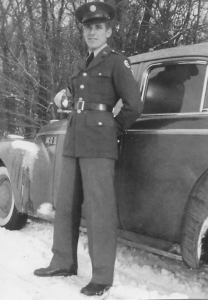
A photo of Mike Raddick, Sr. in front of a car wearing a U.S. Army uniform
Detroit, January 1942: On furlough after training

I recently learned a cool story about my grandfather, Michael Raddick, Sr.

In late 1941, like many young men of his generation, he volunteered for the U.S. Army. At age 24 and married, he had never left the American Midwest, and suddenly he was on a train to Camp Beauregard in Louisiana for Basic training. The cool story comes at the end of Basic.

The Sergeant addressed the company and asked who could operate construction equipment. Grandpa raised his hand. Sure, he’d never actually operated construction equipment, but he’d driven cars, and it couldn’t be that different. Right?

Thus he became a member of the Army Corps of Engineers. Suddenly the young man who had never left the Midwest was shipped off to Iran, where he worked on the Trans-Iranian Railway (still in use today) to supply the Soviet Union in its fight against the Nazis. He worked there for three years, met the Shah, and was honorably discharged at the end of the war as a Technician fifth grade (TEC 5), at the time the Engineers’ equivalent of a Corporal. You can read about the operation here at the National Museum of the U.S. Army and at the U.S. Army Corps of Engineers websites.

He returned home and settled in Neville Township, PA, where he became a principal and community leader, and had two children – Aunt Elaine and my Dad. He died in 2005 at age 88, and is buried in Salem, Ohio next to his beloved wife (my grandmother), who died 12 years later.

Headstone reading: Michael Raddick, TEC 5 US Army, World War II, Aug 11 1917 - Sep 24 2005
Rest in peace, Grandpa. You earned it.

This story illustrates what has become something of a trademark strategy in the Raddick family: volunteer for something you are not technically “qualified” for because it sounds cool, then learn fast.

That was how my Dad became a salesman in the lumber industry, and went on to start a successful cabinet supply business.

It’s also how I became a writer/educator/data scientist with a website.

In Russia, Buddha meditates on you!

The world’s most unexpected Buddhist temple:

This is the Golden Temple of Elista, the capital of the Russian Republic of Kalmykia, on the western shore of the Caspian Sea in European Russia. The Kalmyks migrated here in the 1600s from what is now Mongolia.

Kalmykia is thus the only place outside Asia where the predominant religion is Buddhism.

Explore it yourself!

Bonus entertainment: a full-on flame war in reddit’s r/buddhism: “You must be new here. You don’t want to try to debate with me… You are not an awakened being.”